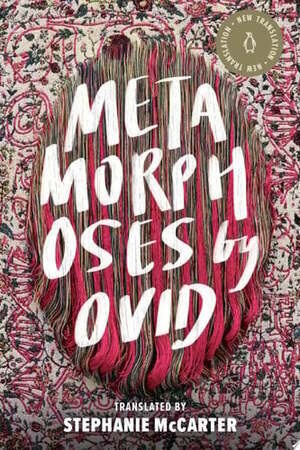
Finished reading: Metamorphoses by Ovid 📚.
I just finished Stephanie McCarter’s translation of Ovid’s Metamorphoses after it was highly recommended to me by a friend and I am buzzing over it.
McCarter’s interview about her translation in The Brooklyn Rail is also epic.
I use iambic pentameter not only because it is the best vehicle for epic poetry in English but also (if I’m being honest) because no other woman had translated the poem into metrical English verse. I wanted to prove, mainly to myself, that it was possible to write a poetic translation, an accurate translation, and a feminist translation all in one.
It is very tempting to commit ourselves to a translation, but part of the fun of reading Ovid in English is looking at various translations and seeing the metamorphoses that this text (appropriately) has undergone. A two-thousand-year-old text needs constant transformation to keep it in conversation with changing times.
To read the Metamorphoses is to be confronted at every turn by the marvelous and the unexpected. Part of this marvelousness is that Ovid refuses to validate easy assumptions. This starts in the poem’s very first lines, where he declares his intention to write of “shapes transformed / into new bodies,” undermining our expectation of “bodies transformed into new shapes.” In Latin, the first (impossible to translate) words are in nova, “into the new,” or even “into strangeness,” sweeping us into a world that is unfamiliar and destabilizing. Entering this world makes it easy to let go of our established notions of what, for instance, a “body” is or of what an epic poem should be. Ovid’s is a world that compels us too to transform.
I think translators should, like Ovid, recognize their narrative subjectivity. We too make all kinds of choices, but translations are usually praised for “objectivity” and “fidelity,” as if the translator’s job is not to make choices. But translators’ choices are always subjective, the result of their own readings and interpretations—we are not human versions of Google Translate.
For Ovid to outlive Rome and continue to be read on people’s lips, he simply must be translated for new times and places, and each iteration gives him replenished life. I hope my translation will help Ovid realize the epic’s powerful last word: vivam, “I will live.”